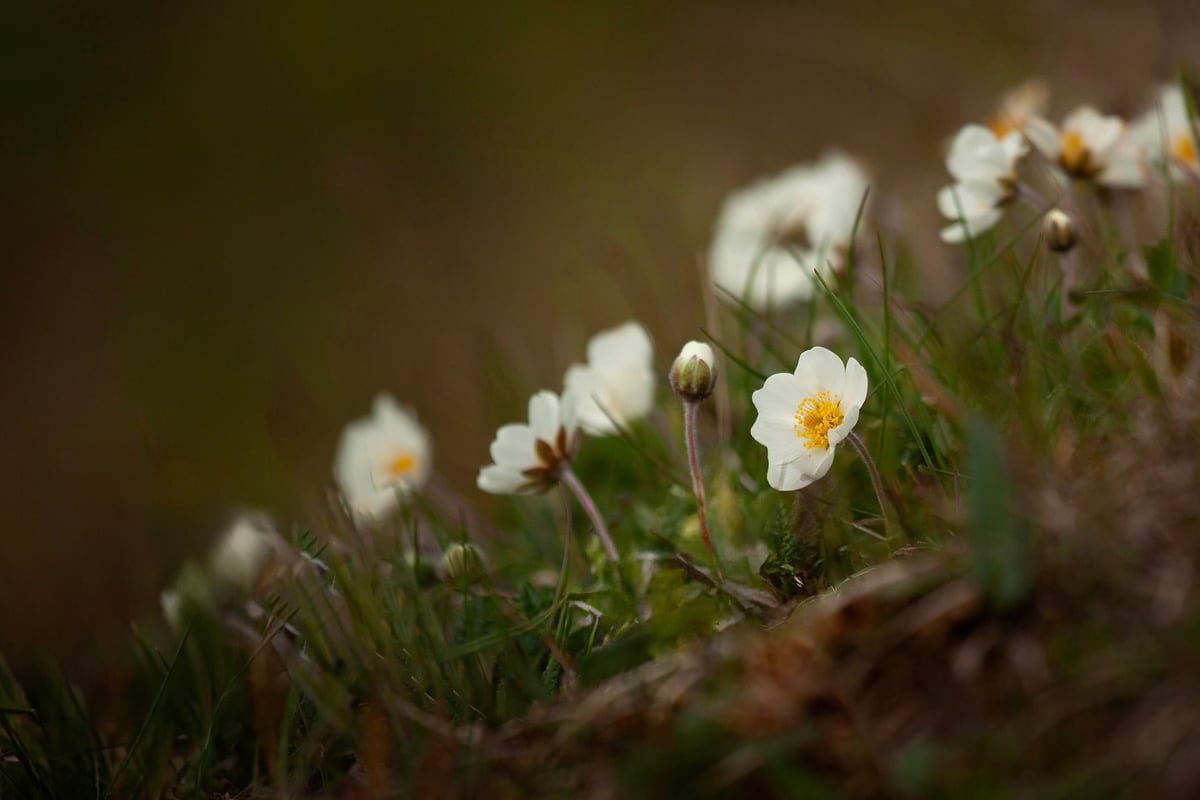
Holtasóley (Dryas octopetala) is common throughout Iceland, and in 2004 it was chosen as the country's national flower. Both photographs in this article were taken near Suðureyri and show the species at two different stages of its annual cycle.
Two faces of the same plant
In the first photograph, white flowers rise just above the surrounding greenery. Pale petals circle yellow centres, while the rest of the mat almost disappears into its surroundings. This plant does not need height or size to catch the eye. The right light and a moment of attention are enough.
The second photograph shows a very different form. The white petals are gone. Long, plumed seed heads stand above the low vegetation in warm light. They look like tiny figures with windblown hair, and it is difficult not to think of them as “little fluffy dolls”.
They are not dried remains without a purpose. After flowering, the styles attached to the fruits lengthen into feathery tails that help the seeds travel on the wind. What may look to us like the decline of a flower is another important stage in its life.
Passing is not always the same as disappearing. Sometimes one form simply gives way so that another can emerge. The white flower becomes a soft, downy head, and what once drew the eye through colour begins to travel.
How to recognise it
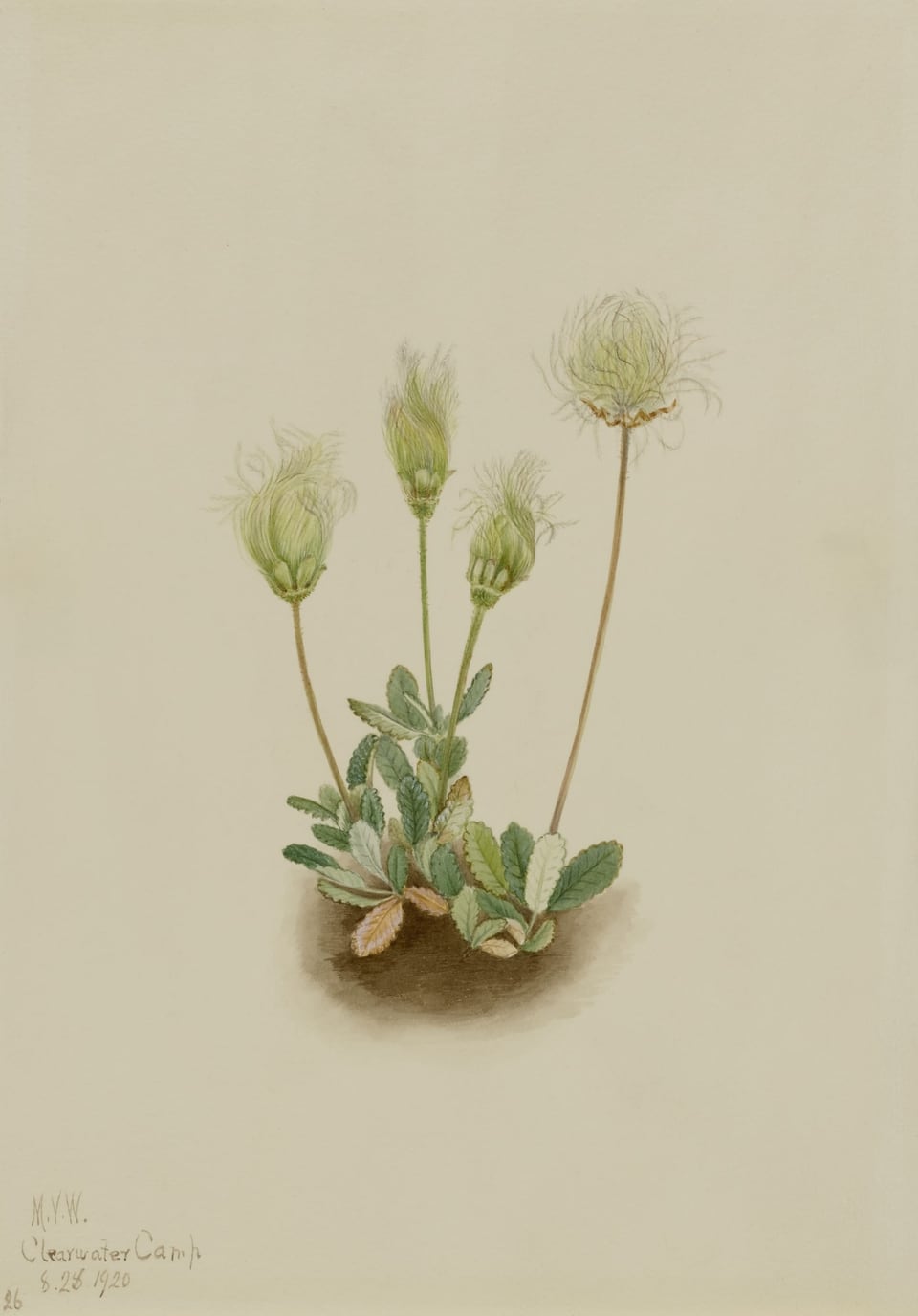
Holtasóley belongs to the rose family. It is a low, creeping subshrub, usually between 5 and 10 centimetres tall, forming flat mats close to the ground. English-language field guides call it mountain avens.
Its leaves are small, leathery and evergreen. They are dark green and slightly glossy above, with a dense covering of white hairs underneath. Their toothed edges can resemble miniature oak leaves.
The large white flowers with yellow centres are the most distinctive feature. They usually have eight petals, reflected in the name octopetala, although the number can vary. The low growth and the shape of the leaves are therefore worth checking as well.
According to Iceland's official nature database, the species flowers mainly in May and June. It then produces many small fruits, whose elongated, feathery tips form a pale, twisted lock that gradually loosens.
How it became the national flower
The choice of Iceland's national flower was not made by one person. In 2004, a working group under the Minister of Agriculture, in cooperation with the ministers responsible for education, transport and the environment, began looking for a plant that could serve as a shared symbol and support teaching and the promotion of Icelandic nature.
Landvernd and the newspaper Morgunblaðið organised a public poll. From 1 to 15 October, people could choose from seven species. The candidates included blóðberg, a wild thyme, hrafnafífa, a cottongrass, and gleym-mér-ei, or forget-me-not.
The result was announced at a meeting in Kópavogur on 22 October 2004. Mountain avens received the highest score and has represented the country ever since.
The winner was not a rarity known only to botanists. People chose a common species found across almost the entire country and recognisable without specialist equipment.
The name changes with the plant
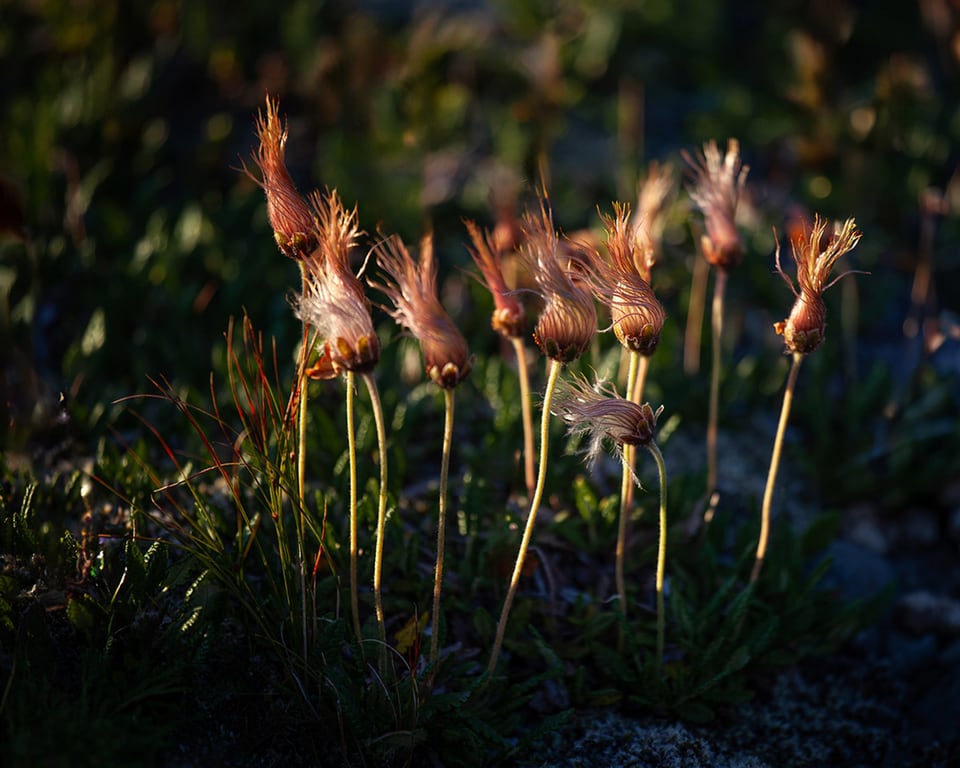
The Icelandic names used for this species change with its appearance. Holtasóley refers mainly to the flowering stage. When the fruits mature and form pale brown, shaggy heads, the plant may be called hárbrúða or hármey. Both names begin with hár, the Icelandic word for hair, and describe their almost human look.
This is the stage shown in the second photograph. The heads look like small figures standing together among the low vegetation. Each is slightly different: some remain tightly curled, while others are beginning to open, their delicate strands moving in the wind.
The leaves have names of their own, rjúpnalauf and rjúpnalyng. The first means ptarmigan leaves, and this is no coincidence. Evergreen foliage is an important food source for the rock ptarmigan, including at times of year when many other plants are unavailable.
Several names for one species reveal how closely people observed its changes. One name was used while it flowered, others when its fruits appeared, and still others reflected its importance to birds.
Where to look for it
Look in dry, open places: gravel ridges, dry heathland, bare scree and rock. This subshrub readily colonises ground with little continuous vegetation.
The official distribution map covers almost all of Iceland, from the lowlands to the mountains. The same database records the species at many sites up to about 1,000 metres above sea level.
When walking, remember to look down as well as ahead. Even in full flower the plant stays low, so it is easy to pass without noticing it.
If you find it after the petals have fallen, you have not arrived too late. You are simply seeing the next part of the same story. The soft heads are not merely what remains of the flower. They are the form that carries the seeds onwards.
There is no need to pick the flowers or move stones for a photograph. Stay on durable ground or an existing path whenever possible, and avoid stepping on the spreading mats.
View holtasóley in Iceland's official nature database
Editor's note: We will gradually be sharing more stories about the plants of the Westfjords on the Sheep Trail Adventures website. We are not planning a catalogue detached from place. We are interested in plants that people can actually see beside the road, on a slope or during a short walk above a valley. Holtasóley is the first.
Back to news