The fjord keeps its own calendar
Many people picture Iceland as empty and bare. The slope above the village encourages that: for most of the year it looks like bare rock. It is not.
Súgandafjörður is closed by mountains on three sides and open to the north. That one sentence explains most of what follows: why the light comes back here later than in the next village, why March is colder than January, and why a slope that looks empty is not.
This chapter is not a survey of Icelandic nature. It is the calendar of one place. Everything you read here as "here" was seen here and has a date. Everything we do not have from this fjord is described as Icelandic and marked as such.
We do not promise animals. You can see a fox, a whale and the northern lights, and we have seen all three here, but a guide that promises a whale loses its credibility on the first outing without one.
One sentence about links
The chapter works without a signal. Links to articles lead to the website and do need one, so everything you need in the field is in the chapter itself.
The year in twelve lines
- JanuaryÍsafjörður celebrates the sun's return on 25 January. Here, not yet. Rowan feeds the redwings, ravens live off the fish plants
- FebruaryIn 2026 the village celebrated sólardagur on 22 February, with coffee and cake in the community hall
- MarchThe coldest month of the year. Whooper swans return around 1 March; in 2026 the golden plover was heard on 7 March
- AprilOystercatcher and plover in place, ptarmigan still white against a dark slope, arctic tern towards the end of the month
- MayThe driest month. Holtasóley begins to flower. The best month for walking
- JuneThe sun does not set from 11 June to 2 July. Flowering peaks. The mushroom season can open this early
- JulyBlóðberg flowers on the dry slopes. Midges in the valley
- AugustBerries. Dark nights from 25 August, the first chance of aurora
- SeptemberAstronomical night from 11 September. The equinox. Great northern divers on the lake with young that can already fend for themselves
- OctoberAdvection fog drawn deep into the valley. In Iceland the old calendar's first day of winter falls on the Saturday between 21 and 27 October
- NovemberThe wettest month. Aurora. The valleys go into shadow. The rowan turns red
- DecemberSolstice on 21 December. Waxwings, redwings and blackbirds at the rowan
| month | length of day | sun at noon |
|---|---|---|
| January | 4 h 30 min | 2.8° |
| February | 8 h 17 min | 11.3° |
| March | 11 h 40 min | 21.9° |
| April | 15 h 24 min | 33.7° |
| May | 19 h 15 min | 42.8° |
| June | the sun does not set | 47.2° |
| July | 21 h 04 min | 45.3° |
| August | 16 h 54 min | 37.8° |
| September | 13 h 09 min | 26.8° |
| October | 9 h 37 min | 15.2° |
| November | 5 h 51 min | 5.3° |
| December | 2 h 49 min | 0.6° |
These figures are calculated for 66.1283 N 23.5397 W and assume a flat horizon. The figure for 21 December in the sky section is shorter because it is the shortest day, not the middle of the month. In the fjord itself the mountains take their share, which is the subject of the last section.
What grows on bare rock
Before the species, one thing that explains the rest. On rock that looks dead the order is always the same: water, algae, the fungi that form lichens, mosses, and only then vascular plants. That is why an "empty" slope is not empty; it is at an earlier stage.
Around 490 vascular plants grow wild in Iceland, counting species brought in that have made themselves at home. The only native gymnosperm is common juniper, which is the shortest possible description of how few trees this island has of its own.
Four species photographed in this fjord
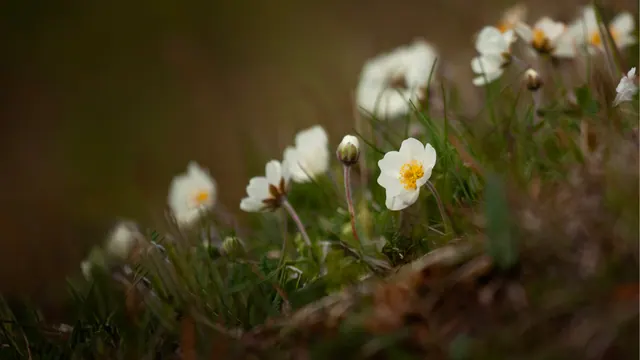
Mountain avens, holtasóley, Dryas octopetala. Iceland's national flower since 2004. Dry heath and rock up to 1000 m, and to 1200 m on Kirkjufjall. It flowers in May and June, but it is often most interesting after flowering, when it turns into feathery seed heads. The leaf, called rjúpnalauf, "ptarmigan leaf", is an important food for that bird.
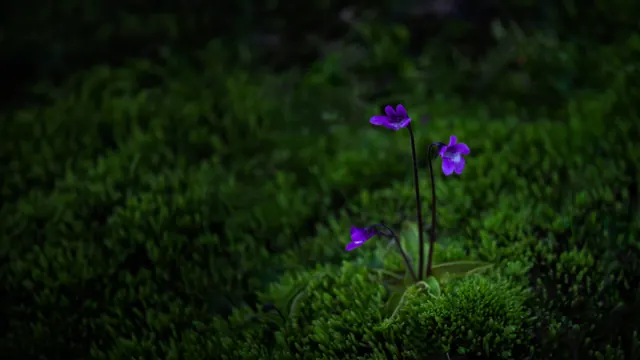
Common butterwort, lyfjagras, Pinguicula vulgaris. One of the two carnivorous plants of Iceland. It grows in wet, mossy places, which is to say exactly where you are already standing to take the photograph. It is the plant on this chapter's opening image and has a section of its own below.
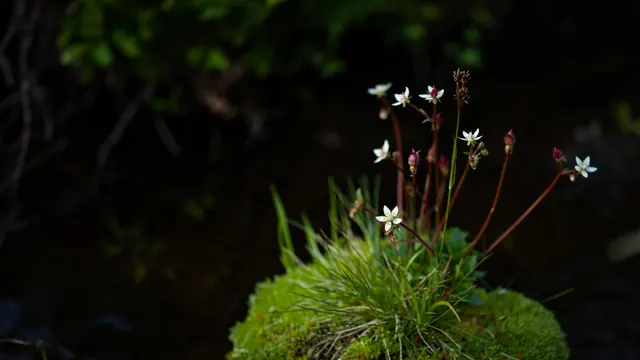
Starry saxifrage, stjörnusteinbrjótur, Saxifraga stellaris. Stream banks, springs and wet ground, from the lowlands to 1000 m. It tolerates strongly acid soils and binds the banks.
Irish saxifrage, toppasteinbrjótur, Saxifraga rosacea. The genus name means "rock breaker", from saxum and frangere, and that is exactly what the plant does over several decades.
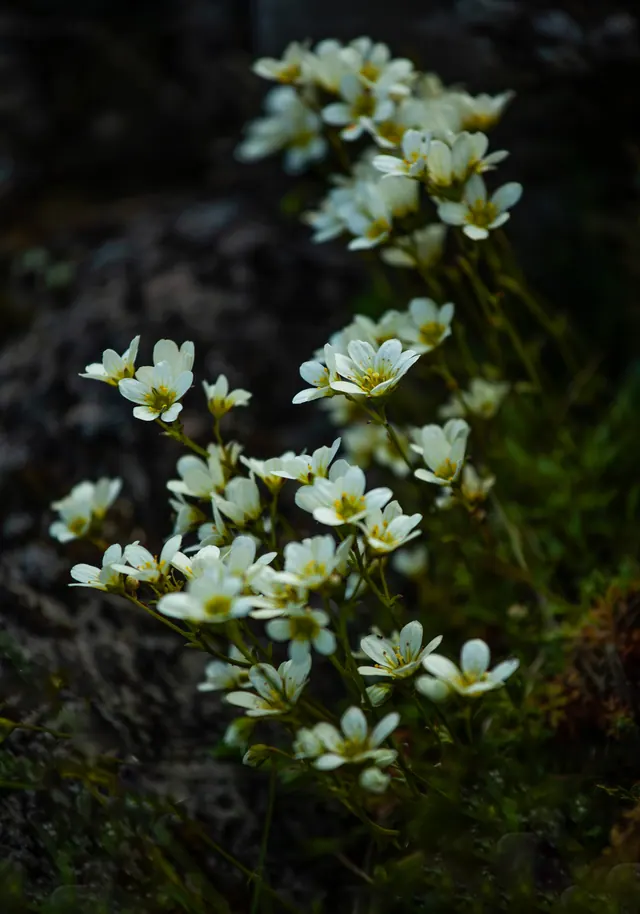
All four were photographed around Suðureyri and in Vatnadalur, that is within walking distance of the village. These are not species you have to drive to.
What else you will see here in summer
- Arctic thyme, blóðberg, Thymus praecox subsp. arcticus: dry rocky slopes to 1070 m, flowers in July, still used as a seasoning for lamb and as a tea
- Thrift, geldingahnappur, Armeria maritima: coasts and rock outcrops, 10 to 30 cm, tolerates salt, binds the soil
- Moss campion, lambagras, Silene acaulis: cushions 5 to 15 cm across that create their own microclimate, warmer than the air around them
- Roseroot, burnirót, Rhodiola rosea: low succulent mats on poor rock, an answer to cold and wind
- Lesser wintergreen, klukkublóm, Pyrola minor: lives in mycorrhiza, so it grows where the fungus is already in the ground
- Frog orchid, barnarót, Dactylorhiza viridis: one of Iceland's few orchids, 5 to 25 cm, up to 50 flowers in the spike
- Sea plantain, kattartunga, Plantago maritima: shoreline and river mouths, the young leaves were eaten
- Garden angelica, ætihvönn, Angelica archangelica: the plant with the longest documented history of use on the island
- Arctic sea rocket, fjörukál, Cakile arctica: a plant of the strand line itself, where nothing else grows
One plant that is not what it seems
Nootka lupin, lúpína, Lupinus nootkatensis, up to 1.5 m, is not native. It was brought in to fix nitrogen and hold the soil, and it does both well. Some conservation opinion now treats it as invasive, because that same nitrogen changes a habitat in which the plants from here were doing fine on very little.
What you can pick, and when
Berries are the only thing in this chapter you can take away with you, so we treat them more carefully than the rest.
| species | in Icelandic | when | how to know it |
|---|---|---|---|
| crowberry | krækiber | August and September | Evergreen dwarf shrub to knee height, berries 5 to 6 mm, black and watery. The commonest berry on the island |
| bilberry | aðalbláber | late July and August | Angled stem, toothed leaf margin. Reckoned the best-tasting |
| bog bilberry | bláber | late July and August | Smooth leaf, rounded stem. Fruit larger and paler, juice colourless |
| stone bramble | hrútaber | second half of summer | A few large red drupelets instead of a solid berry. Unmistakable |
| dwarf cornel | skollaber | late summer | Red berries, edible but bland and mealy. Left to the birds |
| lingonberry | rauðber, týtuber | late summer | A rare find in Iceland. Worth noting, not worth planning around |
| rowan | reynir | autumn through winter | The raw fruit is inedible. It has to be frozen or cooked |
| common juniper | einir | cones ripen over 2 years | A low, spreading shrub. The cones are a seasoning |
Crowberry is the berry you will pick if you pick anything at all. Eaten raw, made into jam, juice and liqueur, and once used as a natural dye.
Bilberry likes places where the snow lies deep in winter, which puts the Westfjords on its side; it is scarcer in the dry south and the interior.
Rowan does not form large woods here; it grows on steep slopes and rock ledges. Raw fruit is inedible because of parasorbic acid. In winter the tree is a canteen for waxwings, redwings and blackbirds, and they spread its seed in return. Reciprocity in its plainest form.
Juniper was here before the settlement and survived as a low, spreading shrub. It is Iceland's only native gymnosperm.
Mushrooms
The season opens somewhere between late June and late July, and that spread is the content, not a fault: in 2025 we called it on 25 June, in 2024 not until 21 July. What you will most often meet is the suede bolete, lyngflosi, Xerocomus subtomentosus, with a velvety olive-brown cap whose yellowish pores do not turn blue, and the birch bolete, kúalubbi, Leccinum scabrum, common here and good for drying.
An honest caveat
We have photographed crowberry, rowan and juniper here. Bilberry, bog bilberry, stone bramble, dwarf cornel and lingonberry we have not, so we write about those as species of Iceland rather than of this slope. When we find them here, this paragraph will change.
One walk in the second half of August with a photograph of each of the first three turns them from "occurs in Iceland" into "grows here". That is the whole difference between our chapter and someone else's, and it costs one afternoon.
The plants that were used here
The rule for this section, written at the top so that it is visible. We write about what these plants were used for and what is documented about them. We do not write about what they cure. That is not legal caution but honesty: the difference between "this is what people did" and "this works" is the difference between history and a promise, and a guide is entitled to the first and not to the second.
The plant whose name is the whole story
Common butterwort, lyfjagras, Pinguicula vulgaris. The Icelandic name means literally "medicine herb", and it is the only plant in this chapter whose own name is evidence of how it was regarded. It grows in wet, mossy ground, stands 5 to 10 cm high, flowers in June with a dark violet spurred flower, and is one of Iceland's two carnivorous plants: insects stick to the mucus on the upper surface of the leaves, and the plant breaks them down and lives off them. It is common throughout the country from the lowlands to 800 m, and the highest record is at 930 m.
Its second Icelandic name, hleypigras, points to a use that has nothing to do with medicine: an enzyme from its leaves was used to curdle milk for skyr. A plant that digests insects also digests milk protein.
The one plant here with a European file
Iceland moss, fjallagrös, Cetraria islandica, is not a plant but a lichen, a fungus and an alga living as one organism. It grows a few millimetres a year and is an indicator of clean air. It was gathered and boiled, and it went into soup and into bread.
It is also the only species in this chapter assessed by a European regulator, and it is worth setting that out precisely, because almost nobody does. The Committee on Herbal Medicinal Products of the European Medicines Agency accepted two traditional uses, both taken by mouth: as a demulcent for the symptomatic treatment of irritation of the mouth and throat with the dry cough that goes with it, and for temporary loss of appetite.
What it did not accept matters more:
- it did not accept well-established medicinal use. The report says plainly that none of the data meet the requirements for demonstrating well-established use with recognised efficacy. "Traditional" here means it has been used long enough to be permitted. It does not mean it has been shown to work
- it did not recommend use on the skin. Cases of contact dermatitis in people sensitised to lichens are on record
- it had no genotoxicity data. There are no published studies, and that absence is why the species was not put on the Community list
A seasoning that stayed a seasoning
Arctic thyme, blóðberg, Thymus praecox subsp. arcticus, grows on dry rocky slopes to 1070 m and flowers in July. It is still used as a seasoning for lamb and as a tea. It is the most living use in this section: not history but cooking.
Garden angelica, ætihvönn, Angelica archangelica, has the longest documented history of use of any plant on the island. The stems and the root were eaten, it was carried abroad as an export, and the right to gather it was worth arguing over. Today it is mostly a plant you walk past.
One thing that is a warning, not advice
Rowan, reynir, Sorbus aucuparia: the raw fruit is inedible because of parasorbic acid, and it has to be frozen or heated. That is not a claim about health; it is a statement about what happens if you eat a handful straight off the tree.
What this section does not contain and will not
- not one sentence about what any of these plants is good for
- doses, infusion recipes and quantities
- the words "cleanses", "strengthens", "supports immunity"
- laboratory studies offered as evidence of an effect in people
Who arrives, who stays
The raven, hrafn, Corvus corax, is here all year and is the bird to begin with, because it explains the village better than the landscape does. The largest flock we have counted was about 30 birds inside the village itself, on 22 February 2026. The ravens here have learned to live off the waste of the fishing industry. This is not the bird of the sagas; it is a bird that has found itself a place in an economy.
The snow bunting, snjótittlingur, Plectrophenax nivalis, winters here and leaves in spring for less accessible ground. It is 15 to 18 cm, almost entirely white in winter with black wings. It raises young at temperatures down to minus 30.
The rock ptarmigan, rjúpa, Lagopus muta, changes plumage three times a year, and males can stay white until the end of May. We saw one white against a dark slope on 13 April, which matches the source to the day. On the Icelandic red list it is near threatened.
Two species nest on Stóravatn, both every year. The lake lies 146 m above sea level, is about 1.7 km across, and the source of the river Vatnadalsá rises some 20 m from the shore, so hidden in the ground that you can pass within a few metres and not notice it.
The great northern diver, himbrimi, Gavia immer, is the bird here worth knowing most about, because it is the rarest. It breeds only in North America, Greenland and Iceland. In European terms that means: here. The Icelandic population is 200 to 300 pairs, with around 500 known territories and nest sites. On the Icelandic red list it is vulnerable, because there are fewer than a thousand mature birds in the country; it was moved down from a higher category in 2000, so things have improved, but not enough to stop counting.
And here is what makes our lake interesting. Náttúrufræðistofnun lists the diver's main breeding areas in Iceland: Mýrar, the heaths above Dalir, Húnavatnssýsla, Borgarfjörður, Skagi, Norður-Slétta, the Mývatn district and Veiðivötn. The Westfjords are not on that list. That does not mean the diver is absent here. It is here, and it nests on Stóravatn every year. That is an observation from this fjord, repeated over years, not an inference from a map. What it means is that the pair on Stóravatn sits outside the areas described as its strongholds, and that is exactly why it is worth counting.
The diver is built for diving and pays for it on land: its legs are set so far back that it walks with difficulty, and it needs a long run across water to take off. From land it cannot take off at all. The lake is therefore not a resting place for it but its whole world for the breeding season. The young spend their first days riding on their parents' backs.
The best time to see one is autumn, when the young can fend for themselves and the birds keep to open water. In winter divers move to the sea and are seen along the coast.
How to behave
This is a vulnerable species nesting at the water's edge. Watch from the shore and at a distance. Do not approach a nest and do not put yourself between the birds and the water. One disturbance at the wrong moment costs a brood.
The whooper swan, álft, Cygnus cygnus, nests at the far end of the same lake, also every year, and returns around 1 March.
Spring has two messengers: the oystercatcher, tjaldur, Haematopus ostralegus, and the golden plover, heiðlóa, Pluvialis apricaria. We see both here, and the plover is heard before it is seen.
The plover carries the most interesting number in this chapter. Between 1798 and 1839 its arrival was recorded on average on 19 April. In 2026 it was heard on 7 March. That is a shift of about four weeks in 200 years, documented in tables rather than felt. Two hundred years ago someone wrote down the day he first heard this bird, and because of that we know today how much earlier spring comes.
The arctic tern, kría, Sterna paradisaea, arrives around 21 April, and in 2026 on 8 April. The whimbrel, spói, Numenius phaeopus, around 17 April, and between 2024 and 2026 after 9 April. The pink-footed goose, heiðagæs, Anser brachyrhynchus, has moved from early April to mid-March. Those four species, together with the whooper swan, show a statistically significant trend towards earlier arrival. The greylag goose, grágæs, Anser anser, passes over the fields and usually only rests.
The cliffs: three species, not four. Göltur and Sauðanes hold the black-legged kittiwake, rita, Rissa tridactyla, the northern fulmar, fýll, Fulmarus glacialis, and the common eider, æður, Somateria mollissima, the last of these more by the water than on the face itself. We do not put the puffin in. It is the first bird anyone expects on an Icelandic cliff, and that is exactly why it has to be said plainly that we do not see it on these two. A guide that promises a puffin where there is none spoils a whole chapter in a single word.
Terns in the village, and a colony that moved. The kría nests not only on the shore but among the houses. The colony at the end of the village moved after an acoustic bird-scaring device was installed nearby.
This is an observation that is in no guidebook and in no institutional source: one device shifted a colony within a village. We report it without judgement and without pointing at whose device it is. The arctic tern comes here from the other end of the world, and a scarer works on everything that flies, not only on what it was meant to deter.
Birds of the valleys. In the valleys of the Westfjords, in the scrub and on damp meadows, the commonest bird is the redwing, followed by the meadow pipit, þúfutittlingur, Anthus pratensis, and the common snipe, hrossagaukur, Gallinago gallinago. The Icelandic name of the snipe is made of the words for "horse" and "cuckoo", and comes from the sound the bird makes in its display flight: not a call but the vibration of its tail feathers, which sounds like distant neighing. Along the shore and in wet ground the common redshank, stelkur, Tringa totanus, is numerous. On open heath it is mostly plovers and pipits.
These four are described as valley birds of the Westfjords and not as our own observations, because they come from Náttúrustofa Vestfjarða's counts in Gufudalssveit and not from our archive. "Here" belongs only to what we have from this fjord.
Winter belongs to the rowan. The waxwing, silkitoppi, Bombycilla garrulus, crested and with a ringing call. The redwing, skógarþröstur, Turdus iliacus. The fieldfare, gráþröstur, Turdus pilaris. And the blackbird, svartþröstur, Turdus merula, black as lava, with a bill like winter sun.
The fox, the seal, and what we do not promise
The arctic fox, melrakki or tófa, Vulpes lagopus, is Iceland's only native land mammal. We see it often on the way to Stóravatn, and every time it runs, startled to find a person there. At Hornstrandir, a few dozen kilometres away, the foxes come closer out of curiosity. That difference says more about people than about foxes. At Hornstrandir the species has been protected since 1995.
On the coast up to 80 per cent of the animals are brown, not white, so the fox you see will probably not look the way you imagine it. On the way to Stóravatn we see both, white and brown, and that fits the source as well: eighty per cent is not all of them.
The harbour seal, landselur, Phoca vitulina, has its highest density in the whole country here in the north-west. At the same time its population fell by 69 per cent between 1980 and 2018, and the species is endangered on the Icelandic red list. Seals come to the pupping places in April and May and nurse their young for about four weeks.
We do see them here, but without a photograph and without a date, so we say it carefully: there are seals in this fjord, and that is as much as we can honestly claim. One photograph with a date would turn that sentence into an observation of our own, as with the ravens and the ptarmigan.
Whales. In August 2025 we saw four humpbacks off Bolungarvík. A humpback grows to 16 m and 30 tonnes, and its song can last 20 minutes and carry for many miles. Minke whale, orca and occasionally blue whale are also found in Westfjords waters.
That was one sighting in two years, and that is how we report it. We do not promise a whale.
What is not here. There are no snakes and no amphibians, and there is no animal here that is dangerous to you. The only thing that bites is the midges in the valley in July.
Light, aurora and weather
The sun does not set here from 11 June to 2 July, twenty-two days. And yet Suðureyri lies at 66°08' N, about 16 km below the Arctic Circle, so there is no true midnight sun here. Refraction and the diameter of the disc are enough. That is the whole truth of the matter, whatever some offers promise.
On 21 December the day lasts 2 h 36 min, and at noon the sun stands one degree above the horizon.
The contradiction that is the heart of this place
Calculation says the sun is above the horizon at Suðureyri throughout December. The residents celebrate its return in February: in 2026 that fell on 22 February, with coffee and cake in the community hall, and the first rays had been seen earlier. In Ísafjörður, in the same region, sólardagurinn is kept on 25 January.
Almost a month between two villages on the same fjord comes from the mountains here being higher and closer. The mathematical horizon is not the horizon you see from Suðureyri, and that is the one thing really worth knowing about light in this village.
Aurora
The window of dark nights runs from 25 August to 19 April, and astronomical night from 11 September to 2 April. The earliest aurora we have recorded was on 10 September. A full moon can wash it out to invisibility, so the lunar calendar matters here as much as the solar activity forecast.
Weather
The coldest month is March, not January. The driest is May, the wettest November, and the difference between them is almost fourfold. That is the argument for May and June if you plan to walk. The figures are averages for 1961 to 1989 from the Veðurstofa Íslands station no. 248 Suðureyri.
Two phenomena are worth knowing, because they happen here more often than elsewhere. A roll cloud, a horizontal bar of cloud like a cylinder lying on its side, forms when moist air off the ocean is pushed up the slopes; its smooth, wavy shape betrays a stable layer in the atmosphere. And advection fog, when warm moist sea air moves over cooler land, with the narrow valleys of the fjord acting as channels that draw it inland.
One thing almost every guidebook has wrong today
For years it was repeated that Iceland is one of the few places on earth without mosquitoes. In October 2025 the first ones were found here, Culiseta annulata, three individuals. Three individuals are not yet a population, and it does not mean there are mosquitoes in this fjord. What bites in Vatnadalur in summer is midges, and they can be a nuisance.
Details about wind, road conditions and what to check before setting out are in chapter one.
Walking routes · in preparation
Contents