
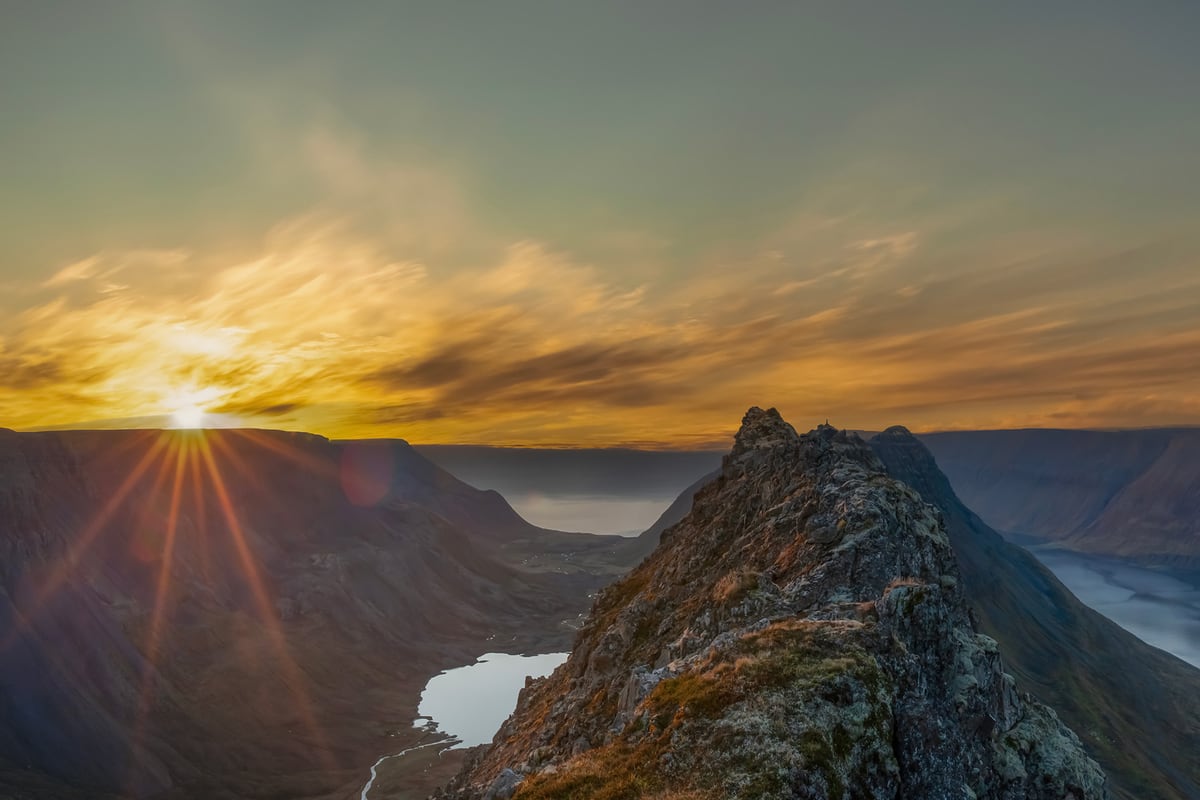
Light over Súgandafjörður usually changes without following a timetable. Wednesday 12 August 2026 was different. The Moon’s movement could be timed almost to the second, and it completely covered the Sun in Suðureyri for 1 minute and 46 seconds.
According to Eclipse 2026, this was the first total solar eclipse visible from the Westfjords since 30 March 1131. That makes the event exceptionally rare. Until the last moment, though, it was not certain whether the sky would clear.
Five key moments in Suðureyri
All times are local Icelandic time, which is UTC.
The partial eclipse started at 16:43:00, when the Moon began to move across the Sun. At 17:43:46, the Sun disappeared completely behind the Moon. Maximum eclipse came at 17:44:39.
The first bright part of the Sun returned at 17:45:32, bringing totality to an end. The Moon kept moving away until 18:43:48, when the eclipse ended in Suðureyri.
- The Moon began to cover the Sun.
- The Sun disappeared behind the Moon.
- Maximum eclipse.
- The Sun reappeared.
- The Sun’s disc was fully visible again.
Remove eclipse glasses only while the Moon completely covers the Sun’s bright face — in Suðureyri from 17:43:46 to 17:45:32. Put them back on as soon as the first bright part of the disc reappears.
The diagram shows the sequence of the event, not proportional timings. Totality in Suðureyri lasted 1 minute and 46 seconds. Data: Eclipse 2026. Graphic: Sheep Trail Adventures.
The Sun and Moon are on schedule. The clouds have made no promise
The forecasts below are a historical record from the days before the eclipse and do not describe today’s weather. The eclipse-area forecast, issued at 22:43 on 11 August 2026, expected cloudy and wet weather, while placing the best chance of breaks in cloud around Breiðafjörður and the Westfjords. Forecasters noted that considerable uncertainty remained. A newer regional bulletin for the Westfjords, issued at 09:56 on 12 August 2026, expected north-easterly or variable wind of 3 to 8 m/s, thickening cloud after midday and intermittent precipitation in the afternoon and evening, the hours in which the eclipse took place.
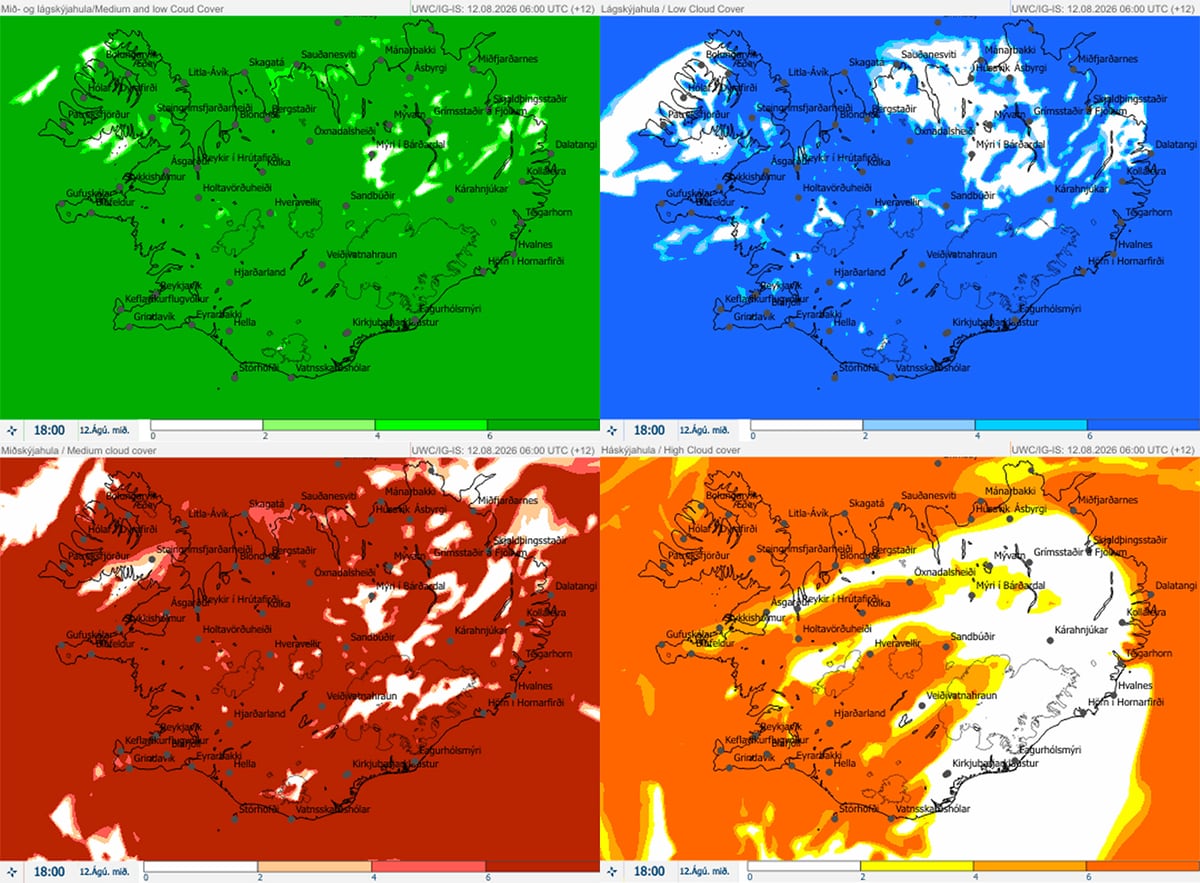
Forecasters stressed that small gaps in cloud cannot be predicted precisely. The forecast was not hopeless, but it gave no certainty of clear skies.
The honest conclusion before the eclipse was simple. A break in the cloud was possible, particularly in the Westfjords, but nobody could identify a place guaranteed to remain clear.
How to watch the eclipse safely
Use proper eclipse glasses or a safe handheld solar viewer throughout the partial phases. Ordinary sunglasses are not safe, regardless of how dark they are. Eclipse glasses should meet the ISO 12312-2 standard and must not be scratched, torn or otherwise damaged.
Remove the glasses only when the Moon completely covers the Sun’s bright face. In Suðureyri, that period ran from 17:43:46 to 17:45:32. Put the glasses on again immediately when the first bright part of the Sun reappears.
Never look at the Sun through a camera, binoculars or a telescope unless a suitable solar filter is secured over the front of the equipment. Eclipse glasses worn over your eyes do not protect against concentrated sunlight passing through optical equipment.
How people were advised to prepare
Distances in the Westfjords are longer than they appear on a map, and the weather can change faster than you can drive from one fjord to the next. Eclipse 2026 advised people to arrive early and warned that journeys might take much longer than usual.
The advice was straightforward: choose a place with as open a view as possible, bring warm waterproof clothing, and do not park in a way that blocks roads or driveways.
Sources and verification
Eclipse 2026 — timings and Westfjords information, checked 11 August 2026.
Icelandic Meteorological Office — eclipse-area forecast, forecast issued at 22:43 on 11 August 2026.
Icelandic Meteorological Office — Westfjords text forecast, updated at 09:56 on 12 August 2026.
NASA — eclipse viewing safety, checked 11 August 2026.
Cloud cover forecast (IG/Harmonie model), Icelandic Meteorological Office — four cloud layers (low, medium, high, combined), data retrieved August 12, 2026.
Back to news