
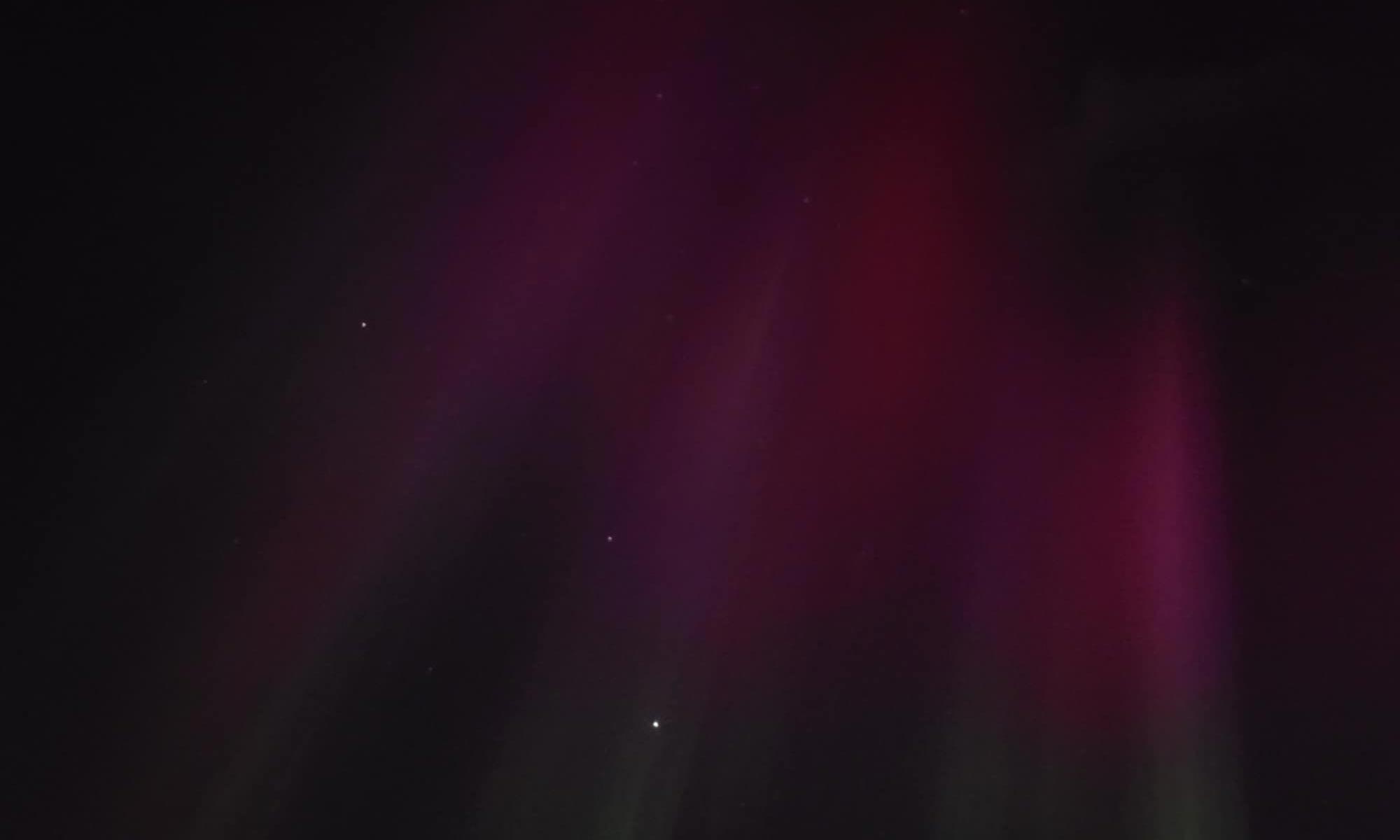
Today, we’re sharing another set of photos from yesterday’s breathtaking spectacle. Alongside these visuals, we’d like to delve a bit deeper into the topic – it’s incredibly fascinating, and we’re sure you’ll find it just as captivating as we do.
The Crimson Aurora – Symbolism, Mythology, and Significance in Nordic Culture
The aurora borealis has captivated the inhabitants of northern regions for centuries, serving as a source of inspiration for myths, legends, and cultural beliefs. In Nordic culture, where nature was revered as a force of both beauty and power, phenomena like the aurora carried profound symbolic significance. One of the most fascinating aspects is the interpretation of the so-called “crimson aurora” – the red-tinged northern lights, which evoked a mix of awe and trepidation. Why did it hold such a strong influence? Let’s delve into the rich world of mythology and symbolism surrounding this extraordinary phenomenon.
The Crimson Aurora in Nordic Mythology
In Nordic mythology, every natural phenomenon was woven into the cosmic order of the world. The aurora borealis, especially its rare red glow, was often seen as a sign of divine intervention or the presence of supernatural forces. It was frequently linked to the Valkyries – Odin’s warrior maidens who chose fallen warriors on the battlefield and guided their souls to Valhalla. The red light of the aurora was imagined as the gleam of the Valkyries’ shields or the reflection of their shining armor as they moved across the sky.
Another interpretation connected the aurora to Bifröst, the rainbow bridge that linked Midgard, the realm of humans, with Asgard, the home of the gods. The vivid colors of the aurora, including its deep crimson hue, were thought to signify activity on the bridge and the flow of energy between worlds. Its appearance could be taken as an omen of great events in the divine realm – perhaps even a prelude to Ragnarok, the apocalyptic end-of-the-world battle foretold in Nordic tradition.
The Symbolism of the Crimson Aurora
In Nordic culture, the color red carried powerful connotations, symbolizing life, vitality, and energy, but also death, conflict, and danger. A red aurora, therefore, inspired both awe and fear, often regarded as an omen of significant and possibly ominous events.
For the people of the north, living in an environment shaped by unpredictable natural forces, such phenomena were seen as harbingers of change – whether wars, natural disasters, or other monumental occurrences.
Folk beliefs sometimes interpreted red auroras as the blood of gods or spirits spilled in cosmic battles, seeping into the skies visible to mortals. Alternatively, they were thought to symbolize the celestial combat of the Einherjar – fallen warriors in Valhalla who trained for the ultimate battle alongside Odin.
Scientific Explanation of the Crimson Aurora
The aurora borealis occurs when charged particles from the solar wind interact with Earth’s magnetic field and upper atmosphere. These collisions energize atoms and molecules, causing them to emit light at specific wavelengths, which we perceive as various colors.
The red light of the aurora is produced by the excitation of oxygen atoms at high altitudes, typically above 200 kilometers (125 miles). When these oxygen atoms return to their ground state, they release energy in the form of red light with a wavelength of approximately 630 nanometers. This rare crimson hue requires specific conditions – including low atmospheric density and relatively low-energy interactions – which is why it is less common than the more familiar green auroras.
Crimson auroras are often observed during intense geomagnetic storms, when solar particles penetrate deeper into Earth’s atmosphere and excite higher-altitude oxygen atoms. This combination of rarity and intensity makes the crimson aurora one of the most striking and memorable displays of natural light.
The crimson aurora serves as a stunning reminder of how nature has inspired human imagination throughout history. While ancient Nordic peoples interpreted it as a mystical omen tied to their gods and myths, modern science offers a deeper understanding of its physical origins. Yet, whether viewed through the lens of mythology or physics, the crimson aurora remains a breathtaking spectacle that continues to captivate and inspire.
Whats up very cool web site!! Guy .. Excellent .. Wonderful ..
I will bookmark your web site and take the feeds also?
I’m happy to find so many helpful info right
here in the post, we’d like work out extra
techniques in this regard, thanks for sharing. . . .
. .
Thank you, we don’t have time to manage website. More info is at our fb page.